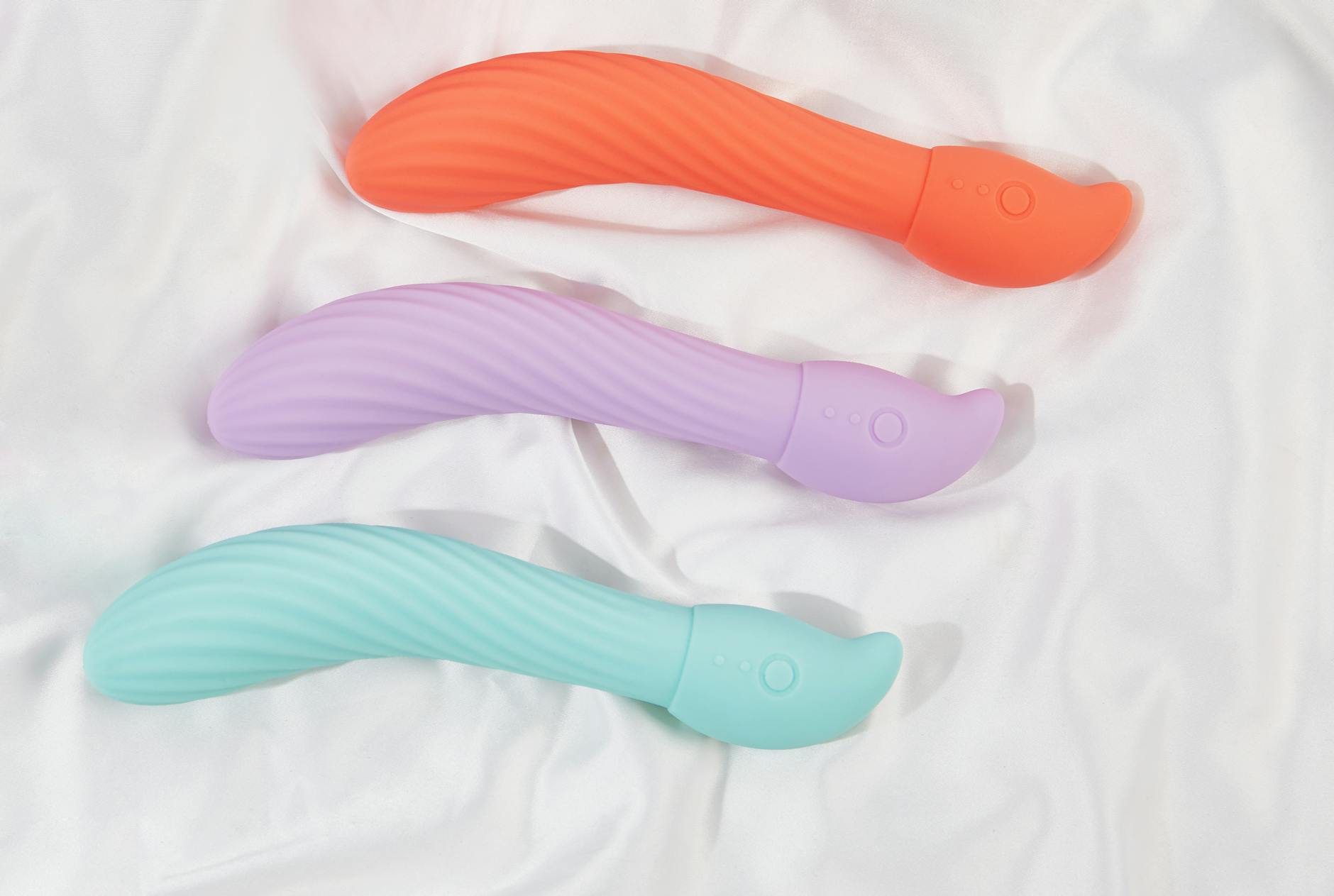
Here's the thing about your cycle and your lemon vibrator
You use the same clitoral vibrator every week, but it doesn't feel the same every week. Some days the Lem feels incredible, responsive, almost electric. Other days it feels muted, like you're working harder for the same payoff. You're not imagining it. Your hormones are literally changing how your nerve endings fire, how much blood flows to your vulva, and how quickly your arousal builds.
This isn't a flaw in your toy or your body. It's biology, and understanding it means you stop blaming yourself for a "bad" session and start working with your cycle instead of against it.
What estrogen does to sensation
Estrogen rises in the follicular phase (roughly days 1-14 of your cycle) and peaks right before ovulation. During this window, your clitoris engorges slightly. Blood flow increases. Vaginal tissue becomes thicker and more elastic. The sensory cortex in your brain literally lights up more in response to touch.
That's not poetic. That's literally measurable on an fMRI.
When estrogen is high, a lemon clitoral vibrator feels more responsive because you have more tissue volume and better blood perfusion. Nerve endings have more "substrate" to fire through. The suction sensation feels deeper, more resonant. This is why the follicular phase is often when people report their most intense orgasms. Everything is working at maximum sensitivity.
Conversely, in the luteal phase (after ovulation), estrogen drops again. Your clitoris is less engorged. Tissue is thinner. Stimulation that felt perfect five days ago now feels either dull or weirdly intense in a way that's almost uncomfortable.
Progesterone's slower burn
Progesterone rises after ovulation and stays elevated until your period. Where estrogen is the quick-response hormone, progesterone is the long game. It slows your whole system down. Your baseline heart rate rises slightly. Your metabolic rate climbs. But your subjective arousal tempo shifts.
This is why many people find that during the luteal phase, direct stimulation on the lemon vibrator feels overstimulating. Your nervous system is already running hotter. Adding intense clitoral suction can feel like too much too fast. You might need to start at a lower pattern, take longer to warm up, or build arousal differently.
Some people report that luteal-phase orgasms, when they happen, feel slower and deeper rather than sharp. It's not better or worse. It's just different. The nervous system is primed differently.
The menstrual phase paradox
During your period itself, two things are happening at once. Estrogen and progesterone both drop, which means you have less clitoral engorgement. But prostaglandins flood your system, which actually increase nerve sensitivity in the pelvic region.
This is why some people report that vibrator use during their period feels either amazing or impossible. If your period cramps are mild, the clitoral vibrator can feel incredibly responsive because your pelvic nerves are firing hard. If cramps are severe, direct stimulation on the clitoris can feel like adding salt to a wound. Your nervous system is already overwhelmed.
For those in the latter camp, this is when a gentler approach works. Lower vibration patterns, longer foreplay, or skipping direct clitoral stimulation entirely in favor of vulval or internal massage.
How arousal speed changes across your cycle
Here's a practical thing that matters: how fast you go from zero to arousal is not constant.
In your follicular phase, especially the few days before ovulation, foreplay that feels leisurely might be exactly right. You can build arousal quickly. Ten minutes of buildup might be all you need.
In the luteal phase, especially the week before your period, that same ten-minute foreplay window often feels too short. You need 15-20 minutes of warm-up before the lemon vibrator even feels good. This isn't a sign of low desire. It's a sign that your sympathetic nervous system (the arousal accelerator) is slower to engage because your parasympathetic system is already activated by progesterone.
Many people interpret this slower buildup as loss of desire and conclude something is wrong. Actually, the desire is there. The access route is just longer.
Lubrication changes too
Cervical mucus consistency shifts across your cycle. So does overall lubrication. In your follicular phase, your vagina naturally produces more fluid. Tissue is more elastic. Water-based lubricant (which every lemon sucker benefits from) glides smoothly and feels natural.
In the luteal phase, less natural lubrication is produced. The same water-based lube might feel sticky or drying. Some people find that switching to a silicone-based lubricant helps, though remember that silicone lube can degrade silicone toys over time, so wipe down your toy afterward.
Others find that the perceived "dryness" is less about actual moisture and more about the fact that tissue is less engorged, so there's less natural give. In that case, more lube (not different lube) is the answer.
The sensitivity bandwidth problem
One more wrinkle: your optimal vibration pattern might actually change. Some people use pattern 2 on the Lem during their follicular phase but need to dial down to pattern 1 during their luteal phase. Others find that what felt too intense last week now feels perfect. This isn't the toy changing. It's your sensory processing changing.
This is why so many people benefit from learning their vibrator at all pattern levels. You're not learning the toy. You're learning yourself across different hormonal states.
If you've always assumed one "best" pattern, track when you use your lemon vibrator and which pattern felt best that day. You might find a clear cycle. That information is gold. It lets you stop blaming the tool and start using it more intelligently.
What helps across all phases
A few things work regardless of where you are in your cycle:
Longer foreplay always wins. Even in your most sensitive days, spending time on the whole vulva, not just the clitoris, primes your nervous system better. Use your lemon clitoral vibrator after you've already spent five minutes on everything else.
Lube is not optional. Even if you feel naturally wet, adding water-based lubricant increases glide and reduces friction irritation that progesterone-phase skin is more sensitive to.
Tracking matters. The single biggest insight I give clients is to simply note down which vibration pattern felt best and how fast arousal built. After three cycles, patterns emerge. That's when you stop fighting your body and start collaborating with it.
Your partner needs to know. If you have a partner, this is information worth sharing. "I need longer foreplay next week" is a completely valid request and it's not about them. It's about cycle biology.
When something is actually wrong
There's a difference between normal cycle-based sensation changes and pain or numbness that persists across all phases. If a lemon vibrator causes pain no matter where you are in your cycle, that's worth investigating with a gynecologist. Same if you notice complete loss of sensation even during your most sensitive days.
For most people though, the cycle rhythm is normal. Your clitoris is not broken. Your lemon vibrator is not broken. You're just living inside a body that changes month to month, and pleasure follows those changes.
The bottom line
Your hormones are not obstacles to pleasure. They're information. By paying attention to what feels good week to week, you start to understand not just your toy but your own nervous system. That knowledge transforms not just solo pleasure but how you communicate with partners about what you need, when you need it. Your cycle isn't something to work around. It's something to work with.
People also ask
Why does my lemon vibrator feel numb during certain weeks?
Numbing during specific weeks usually points to progesterone dominance in your cycle. When progesterone is elevated post-ovulation, your nervous system processes sensations differently, and localized stimulation can feel dampened. This is especially true if you're using the same vibration pattern you'd use in your follicular phase. Try dropping down a vibration pattern, increasing foreplay time, or trying a different area of the vulva. If the numbness persists across all cycle phases, that's worth a conversation with a healthcare provider.
Can I use my lemon clitoral vibrator during my period?
Absolutely, if it feels good to you. Some people find that gentle vibrator use during their period actually helps with cramping and feels amazing. Others find direct clitoral stimulation uncomfortable when their period is heavy or painful. There's no rule here. Listen to what your body tells you. If gentle patterns feel better on day one of your period, start there. You can always adjust.
Does birth control change how my lemon sucker feels?
Yes, significantly. Hormonal birth control prevents the hormone fluctuations that create your natural cycle. This means sensation stays more consistent month to month, but it's also typically flattened compared to your natural peak sensitivity. Barrier methods don't change sensation at all. Some people feel more consistent pleasure on hormonal birth control because they're not dealing with cycle-based sensitivity swings. Others feel like something is missing. Both are normal.
Why do orgasms feel different at different times of my cycle?
Orgasms feel different because the physiological substrate changes. In your follicular phase, orgasms tend to be faster-building and more intense because clitoral engorgement is higher. In your luteal phase, orgasms tend to be slower-building but sometimes deeper and more full-body because progesterone broadens your nervous system's overall activation. Neither is better. They're just different experiences of the same capability.
Should I buy multiple vibrators for different cycle phases?
No. One good lemon vibrator is all you need. What changes is the pattern you use and how long you take to build arousal, not the tool itself. Learning to use one toy across all cycle phases teaches you more about your own sensory map than buying multiple toys ever would. You'll develop real expertise in what works when.
Is it normal for my arousal to be completely gone one week each month?
Low desire during the luteal phase is normal for many people, but "completely gone" warrants attention. Track whether this happens every cycle at the same point and whether other luteal-phase symptoms (energy drops, mood shifts, sleep changes) happen at the same time. It might just be normal cycle variation. It might also be a sign of PMDD (premenstrual dysphoric disorder) or a thyroid issue. If the pattern is consistent and distressing, talk to your doctor about it. Most of the time, desire returns as soon as your period starts.
Ready to understand your own pleasure better?
The best way to navigate cycle-based changes is to pay attention. Spend a few cycles noticing what works, what doesn't, and when. That's the foundation. From there, everything else makes sense. If you'd like help thinking through relationship communication or intimacy shifts across your cycle, reach out to Hello Nancy.
Sources
Bushnell, M. C., Čeko, M., Low, L. A. (2013). Imaging human pain processing. Neuroscience & Biobehavioral Reviews, 37(8), 1859-1877.
Differences in sensory processing based on menstrual cycle phase have been documented in peer-reviewed neuroscience and gynecology literature, including studies on tactile sensitivity and clitoral blood flow variation.
McKay, L. L., Persike, M., Schreiber, L. R. N. (2019). Examining the association between phase of the menstrual cycle and hormonal contraceptive use on women's sexual concordance. Archives of Sexual Behavior, 48(8), 2399-2413.